
‘Stop shaming Gen Z for job-hopping’: Anupam Mittal’s advice to young professionals divides opinion on LinkedIn
Simran Guleria | Feb 03, 2026, 06:27 IST
Anupam Mittal weighs in on Gen Z job-hopping in a viral LinkedIn post, questioning old ideas of career loyalty and redefining early professional growth.

Image credit : X| Freepik| Viral post by Anupam Mittal sparks debate on Gen Z careers
Anupam Mittal has stirred a lively conversation online after pushing back against the growing criticism aimed at Gen Z professionals for switching jobs early in their careers. In a widely shared LinkedIn post, the entrepreneur and Shark Tank India judge argued that job-hopping, when done at the right stage, is less about disloyalty and more about self-awareness.
Mittal, who founded Shaadi.com and leads the People Group, challenged what he described as “lazy career shaming” by senior professionals and so-called gurus. He pointed out that expecting clarity and long-term commitment from workers in their early twenties ignores the reality of how careers actually evolve today. According to him, the first few working years are meant for experimentation, not premature settling.
![LinkedIn| Viral post by Anupam Mittal questions career loyalty norms]()
He likened the process to dating rather than marriage, suggesting that young professionals are still figuring out which industries, roles and workplace cultures suit them best. If a role feels wrong, he said, leaving should not be treated as a failure. Instead, it should be recognised as part of learning what does and does not work.
![X| Anupam Mittal during a public appearance.]()
Mittal argued that frequent switches early on often help individuals identify their strengths faster. Exposure to different environments builds perspective, sharpens judgement and reduces the risk of staying stuck in roles chosen out of fear rather than fit. He stressed that guilt has no place in this exploratory phase, especially when expectations and ambitions are still forming.
However, his advice came with a clear caveat. While exploration is healthy at the start, it cannot become a permanent strategy. Mittal warned that endless movement eventually raises red flags, particularly when professionals begin aiming for leadership roles.
![Freepik| Young professionals collaborate during a workday at a modern office.]()
Drawing from his own hiring experience, he revealed that CVs without at least one sustained four to five year stint rarely make it through for senior positions. Depth, he explained, is built by staying long enough to see the consequences of decisions, not just the excitement of starting something new.
Mittal also shared a practical timeline for young professionals. He suggested exploring aggressively between the ages of 21 and 24, followed by committing to a role or organisation for a minimum of four years after 25. This balance, he believes, allows curiosity without sacrificing credibility.
In the latter part of his post, Mittal emphasised that leadership demands resilience. Staying through difficult phases, cleaning up earlier mistakes and scaling what works are experiences that cannot be gained in short bursts. Understanding a job may take a year, he noted, but understanding an industry takes much longer.
The post resonated strongly with LinkedIn users, many of whom shared personal stories echoing his views. Several praised the nuance of acknowledging both exploration and commitment, while others added that side projects and parallel learning can also accelerate clarity.
![Freepik| Gen Z employees working together in a contemporary workplace.]()
As career paths become less linear and workplace expectations continue to shift, Mittal’s message struck a chord for its balance. Rather than glorifying job-hopping or condemning it outright, he reframed it as a phase to be used wisely. His closing message was simple but pointed: explore freely when you are young, but once you find your fit, stay long enough to truly grow.
Mittal, who founded Shaadi.com and leads the People Group, challenged what he described as “lazy career shaming” by senior professionals and so-called gurus. He pointed out that expecting clarity and long-term commitment from workers in their early twenties ignores the reality of how careers actually evolve today. According to him, the first few working years are meant for experimentation, not premature settling.
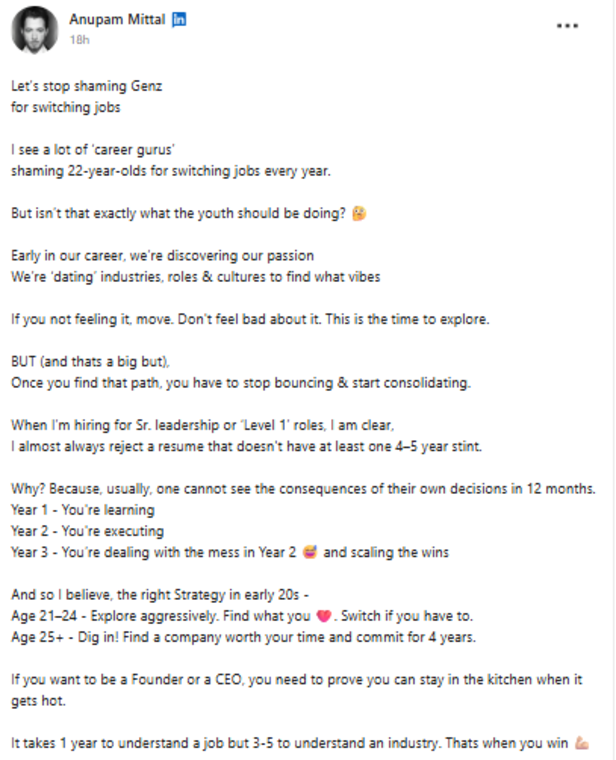
Image credit : LinkedIn| Viral post by Anupam Mittal questions career loyalty norms
He likened the process to dating rather than marriage, suggesting that young professionals are still figuring out which industries, roles and workplace cultures suit them best. If a role feels wrong, he said, leaving should not be treated as a failure. Instead, it should be recognised as part of learning what does and does not work.

Image credit : X| Anupam Mittal during a public appearance.
Why early movement can be a strength
Mittal argued that frequent switches early on often help individuals identify their strengths faster. Exposure to different environments builds perspective, sharpens judgement and reduces the risk of staying stuck in roles chosen out of fear rather than fit. He stressed that guilt has no place in this exploratory phase, especially when expectations and ambitions are still forming.
However, his advice came with a clear caveat. While exploration is healthy at the start, it cannot become a permanent strategy. Mittal warned that endless movement eventually raises red flags, particularly when professionals begin aiming for leadership roles.

Image credit : Freepik| Young professionals collaborate during a workday at a modern office.
Drawing from his own hiring experience, he revealed that CVs without at least one sustained four to five year stint rarely make it through for senior positions. Depth, he explained, is built by staying long enough to see the consequences of decisions, not just the excitement of starting something new.
Mittal also shared a practical timeline for young professionals. He suggested exploring aggressively between the ages of 21 and 24, followed by committing to a role or organisation for a minimum of four years after 25. This balance, he believes, allows curiosity without sacrificing credibility.
When it is time to stop moving
In the latter part of his post, Mittal emphasised that leadership demands resilience. Staying through difficult phases, cleaning up earlier mistakes and scaling what works are experiences that cannot be gained in short bursts. Understanding a job may take a year, he noted, but understanding an industry takes much longer.
The post resonated strongly with LinkedIn users, many of whom shared personal stories echoing his views. Several praised the nuance of acknowledging both exploration and commitment, while others added that side projects and parallel learning can also accelerate clarity.

Image credit : Freepik| Gen Z employees working together in a contemporary workplace.
As career paths become less linear and workplace expectations continue to shift, Mittal’s message struck a chord for its balance. Rather than glorifying job-hopping or condemning it outright, he reframed it as a phase to be used wisely. His closing message was simple but pointed: explore freely when you are young, but once you find your fit, stay long enough to truly grow.
Viral post by Anupam Mittal sparks debate on Gen Z careers
By Simran Guleria

When will Prince Harry return to the U.K.?
By Nancy Jaiswal

Dubai influencer’s Kashmir adventure is giving major travel goals & internet is obsessed
By Sneha Kumari

Free Fire x Dragon Ball Z crossover
By Sneha Kumari

Indonesia restores Grok access under strict conditions
By Nancy Jaiswal

Why Kendrick Lamar’s Grammy 2026 win feels personal to Gen Z
By Sneha Kumari

Budget 2026 pushes Rare Earth corridors in four states
By Nancy Jaiswal
